
Presented by Dr. Jacob N. Yates at ATEC on 25 March, 2026.
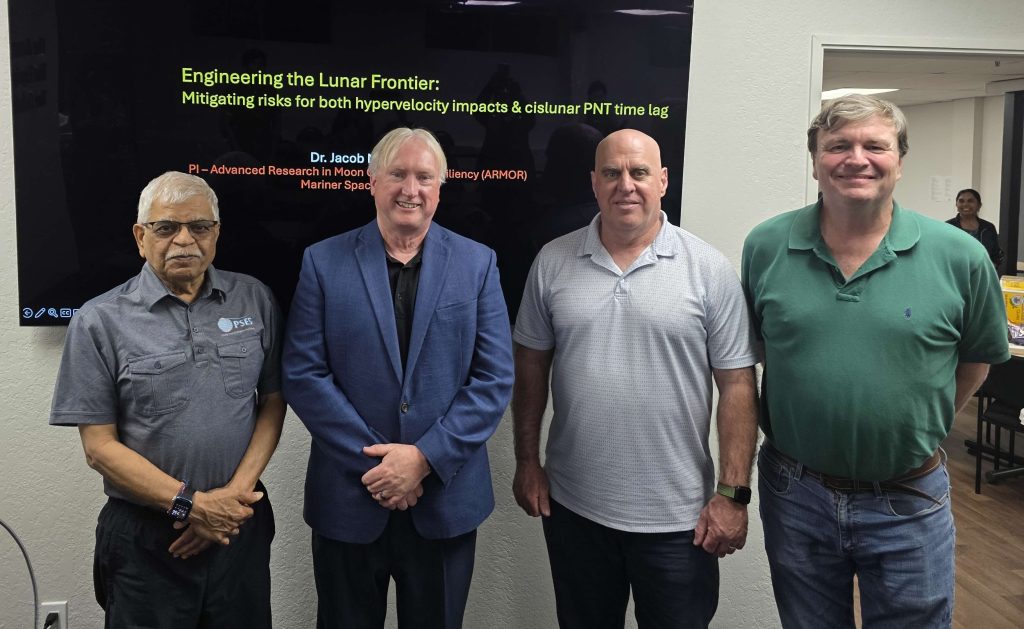
This presentation was planned to be two talks. The first was about returning to the moon and the many materials science challenges that this return will incur. The Moon has no or very little atmosphere, potentially dangerous meteorites and ejecta, and there are significant cislunar Position Navigation and Timing (PNT) challenges. A crucial meeting with Dr. Yates’ collaborators on PNT was pushed to April, so a lot of the details unfortunately won’t be shared tonight. There is a strong possibility that he will come back in the fall, after they have adjudicated their PNT engineering a little bit more. He’ll describe the challenges tonight, though, in order to provide context and motivation for work that must be done in order to have accurate PNT.
We are returning to the moon. The future, Artemis and Beyond. South Pole, return new and diverse samples and increase our datasets. Is this just an Apollo redux? No, not really. This is quite different. Apollo was camping trips. Lunar Prospector, Clementine, etc. lead to belief that South Pole has water. So, we should go there.
High energy impact events as a research focus. How will materials handle the continuous bombardment from space. No atmosphere to slow things down. People believed until the 1960s that the craters were volcanic in origin. This belief was revised after we went to the moon, and found out they were impact craters. A lot of impact craters. Risk mitigation is what our speaker is most focused on. Solar radiation and meteorites are a significant risk. Meteoroid ejecta poses a significant risk to future lunar surface operations. The ejecta was flung over 32 km away. Is this once in a lifetime sort of event? No. It’s every 3-5 years. Characterizing the risk posed by the ejected is crucial. The ejecta sprays out radially. This is almost like improvised explosive devices (IEDs).
Ejecta traveling at hypervelocity speeds? Very destructive, potentially. Do we understand all the parameters associated with the risks? Artemis surface missions are a couple days to two weeks. Artemis 5-6 missions will be 30 days, and this increases the chances of taking a hit from something coming down from space. What can effectively block or degrade lunar meteorite ejecta for future operations?
We don’t really know what the flux rates are. We don’t know what the patterns are. Symmetrical? Asymmetrical? Fine dust? Large boulders? We can see past events, but what about recent events? How do we keep operating? How do we repair things like space suits? We just don’t have a very good handle on this sort of risk analysis.
What does lunar dust do to equipment over long periods of time? It’s a severe problem. Breathing it in causes a type of lung disease similar to COPD or asbestosis. The 17 layer space suits from Apollo mission were abraded quite a bit, and they didn’t do construction or mining. “Sightseeing” astronauts got serious degradation in 3 days. 30 days of hard labor? What will happen to the suits?
Lunar impact flashes are ground-based observations of impact events. CCDs from amateur telescopes have caught routine impact flashes. The flash comes from high temp vapor caused by impact melt. It is difficult to characterize the flux rate because of observational biases. We only see one hemisphere, there’s a lot of earthshine, and weather here on Earth blocks our visibility. The average duration is 30 mS and a few of the longest last a second. It is hard to do a really good light curve with this brief of a flash. Light curve analysis reveals signatures of impact plumes.
Next, the concepts of hypervelocity vs. ballistic speeds were compared and contrasted. Hypervelocity is anything exceeding 1 km/s. Lunar escape velocity is 2.4 km/s. Due to unfortunate circumstances, LDEF (NASA) ended up staying longer in orbit, 5 years, in 1990. The good news is that we got a lot of micrometeorite hits and we got to study them.
The presentation continued with hypervelocity tests at the Impact Lab at TAMU. When stuff hits the moon, it vaporizes and turns into crystalline spheres. They are essentially little glass marbles. They’re found in the regolith highlands. So, our speaker decided to try and mimic those beads and then fire them at speed. So, we have 4 mm AL beads (Iron lithic fragments) and 8 mm glass beads. They were fired at various materials proposed for being on the moon. This was done with a light gas gun to accelerate small projectiles from 1 to 9 km/s to simulate micrometeorite impacts. Then, they looked at what happened. Backlighting the back of the tank increased the ability to see the fine ejecta fired at materials.
The target materials consisted of a variety of potential materials to be used on the lunar surface:
Aerogel, aluminosilicate, EVA suit layer, graphene, regolith simulated, regolith proprietary epoxies, STS thermal tile, spectra fabric type 1, spectra fabric type 2
The goal of the study is to find out how the materials are going to endure through being in lunar environment. LEO materials inside the Van Allen belts and relatively dust free doesn’t really work on the Moon. We need to figure this out by Artemis 5, because that’s when we start building roads, landing strips, water reclamation, and construction projects. Extreme temperatures on the moon mean that things like stainless steel hammers will shatter. The temperature swings are enormous. Craters are -180 degrees. We may be using Nickel hammers instead of stainless steel. Radiation is a huge factor too. Radiation hardened CPUs, chips, etc. will be required.
There’s a lot we don’t know. Long-term exposure in a very very harsh environment has a lot of unknowns. There is a different mindset of going to the Moon vs. being in Low Earth Orbit. It’s a completely different situation. We may have become a bit complacent in terms of understanding the risk.
The presentation concluded with an engaging Q&A session.
Q: what about using what’s on the Moon already?
A: that’s why lunar regolith simulantion is on the chart. Will it be able to withstand the environment better? If we just use what’s there?
Apollo 12 landed near Surveyor 3. When the astronauts brought it back, it was sandblasted from the Apollo 12 blast off. The ejecta plume reached all the way there and damaged it, 1 km away. So, what do we do? Land and then take some other ground transportation, like a trolley or a bus to where you live? To avoid blasting things with ejecta plume from coming and going?
The epoxy+regolith worked well, but the weight to get epoxy up there is really hard. The regolith+epoxy can stop ejecta.
EVA suits really can’t stop this sort of ejecta.
LUMIO Lunar Meteoroid Impact Observer. This is in a Halo orbit around L2 on the other side of the Moon from the Earth. It’s a cubesat. This gives you the far side of the Moon, so you can see the impact flashes better. LUMIO-Cam is a payload on the mission. It has a beam splitter and looks at two different things. If it’s only seen on one of the two beams (purple vs reddish), then it’s not a real impact. It’s just noise.
The time delays matter if you are getting data for precision landing on the moon, and depending on signals such as GPS. Reference emitters are needed. TRANSIT, for submarines to get position. Can we do something like that?
Position Navigation and Timing (PNT) system going out to cislunar, to reduce the GPS bias down by half, are in our near future.
Apollo found thousands of seismic events per year on the Moon. Meteor storms made more happen. Not hundreds, but thousands. In 1977 we shut the sensor off “to save money”. Laser range finders are still on the moon. Retroreflectors are still up there.
LUMIO will give us an unobstructed constant view for a year, and then we will crash it into the Moon to dispose of it properly. It is expected to launch in 2028, possibly from Vandenburg. There’s some educational outreach to high school and college for data sharing that has started up. AIAA American Institute of Aeronautics and Astronautics are a coordinating partner.
The Moon is considered to be a waypoint because you are now out of the gravity well of Earth. Electronics, aeronautics, surface materials, woefully behind in materials science, and we need to catch up.
Q: We have autonomous vehicles here. Why do we need drivers and people on the Moon? Can’t we just use autonomous vehicles?
A: “No bucks no Buck Rogers”. People feel an attachment when people are there doing stuff. “No one cries when a space craft is lost”. (several in the audience disagreed). These are emotional arguments. In the 1970s-1990s, the idea was going to the Moon was purely R&D (allegedly). We understand that there were Cold War reasons too. Now we’re cutting science budgets. We are going to do explorations for the sake of exploration, and not necessarily for science. To address the autonomous vehicle question, specifically mining, there’s no good mining equipment that is autonomous here on Earth. There’s still a ton of problems with self-driving cars. Autonomous vehicles and rovers are really hard to get right. They’re just not ready yet for sending to the Moon. We have to send people there to make things work and fix things right. We can’t even do autonomous mining here on Earth. Artemis missions are mining-oriented, and this rules out most of the autonomous equipment.
Comment: You go to Kennedy Space Center and they say that Neil Armstrong saved the mission. But then we mixed up meters and feet. Human in the loop whether we like it or not often saves the day. Automation is really hard.
Q: What is that picture? (from the title slide) Is that a crater?
A: That is from Apollo 17 and is a large crater. They did not end up going down into the crater, which was a potential original plan.
Q: How often do the really big craters happen?
A: We know the rate of the biggest ones because we know how many big ones get through our atmosphere here on Earth. What we don’t know is how many of the small ones, since those are absorbed by our atmosphere. There are some undisturbed core samples from Apollo missions, that might give us some better ideas.
Q: Circuits degrade quickly, and we are planning to have data centers on the Moon? but data centers have a lot of circuits? Conventional circuits? High frequency circuits?
A: Tech sector jealously guards how they are going to accomplish this. We don’t have much indication yet of how they are planning to handle it.
Q: The Moon used to be part of Earth, so why go mine there instead of here? What is so important about the Moon that we have to go to all the expense and risk to mine there?
A: Great question. In the 1980s they looked at the lunar samples, and its upper mantle stuff, just like Earth. The water ice comes from comets. These comets don’t make it to Earth’s surface. A certain percentage of upper atmosphere water comes from meteorites. Over 4.6 Billion years, there’s got to be a lot of water from comets. The water ice never really evaporates. Rich titanium, rare earth elements. “It’s not worth it” for one rocket mission. But, if you send enough people, to get tungsten, titanium, and other valuable stuff. The most expensive material is Helium 3. Solar wind creates it and it ends up trapped in the soil. It’s covered in Helium 3. Tokamuk fusion reactor uses Helium 3. So, it is worth it, from a certain economics perspective.
Q: For constructing on the surface of the Moon, would the footprint of the building be factored in to the risk assessment? Is there an effort to preserve the lunar surface? It is its own source of data.
A: Old abandoned mines and lava tubes are similar structurally, need a lot of maintenance. Europeans favor using inflatables. Use inflatables and then pile up regolith to make igloo like berms. It turned out that making Lunar bricks on the Moon did not work with sintering. You need water to make bricks. Preservation of the lunar surface isn’t generally a priority, outside of historic landing sites from the Apollo program.
Our speaker closed with a thoughtful and thorough acknowledgement of the people that have inspired and mentored him over the years. Respect was paid to Dr. Jim Arnold, Dr. Sally Ride, Dr. Mike Wiskerchen, Fred Peters, Dr. Mike Gaffey (who advised that real science and engineering if you do it and love it, it is like fun work, like dolphins at play), Dr. Gerald Soffen. Dr. Paul Lowman, Captain Warren Vaneman, RADM Eric Ruttenberg, Dr. Jim Casler.